The Enabling Layer · Issue 07 · Newsletter
Making sense of your business systems: one building, five floors
Let's make more money, cut costs, simplify your business, and free up your time.
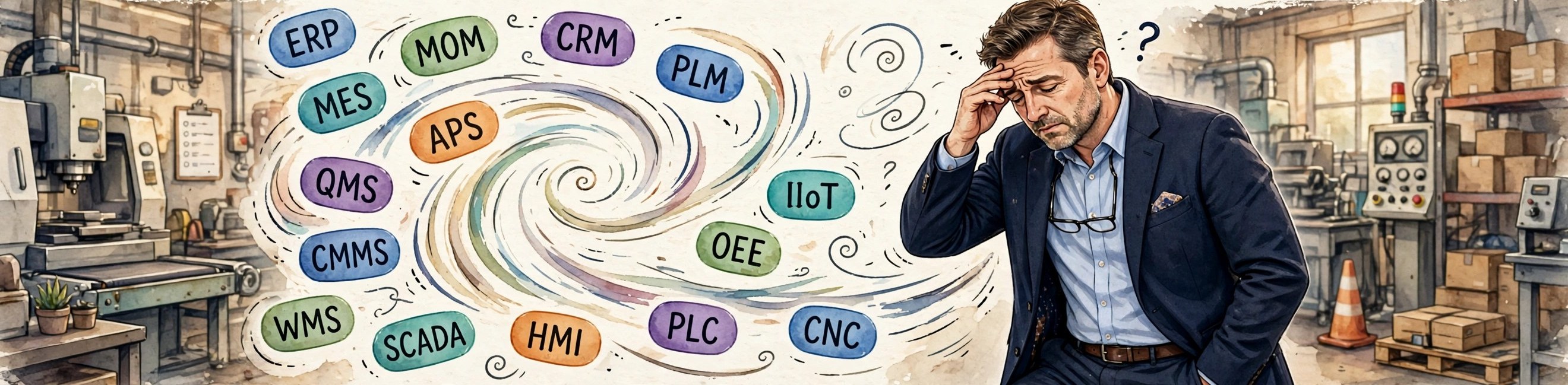
Somewhere this month, a software salesperson is sitting across from a plant owner, and the letters are multiplying. "Our ERP talks to the MES, the MES reads your PLCs through SCADA, and the OEE dashboard sits on top." The owner nods. He has heard most of those letters before. He is not sure which ones he already owns. Then he walks back out to a floor that runs on paper travelers, a whiteboard schedule, and one supervisor's memory — because nobody drew him the map. Here is the map.
One building, five floors
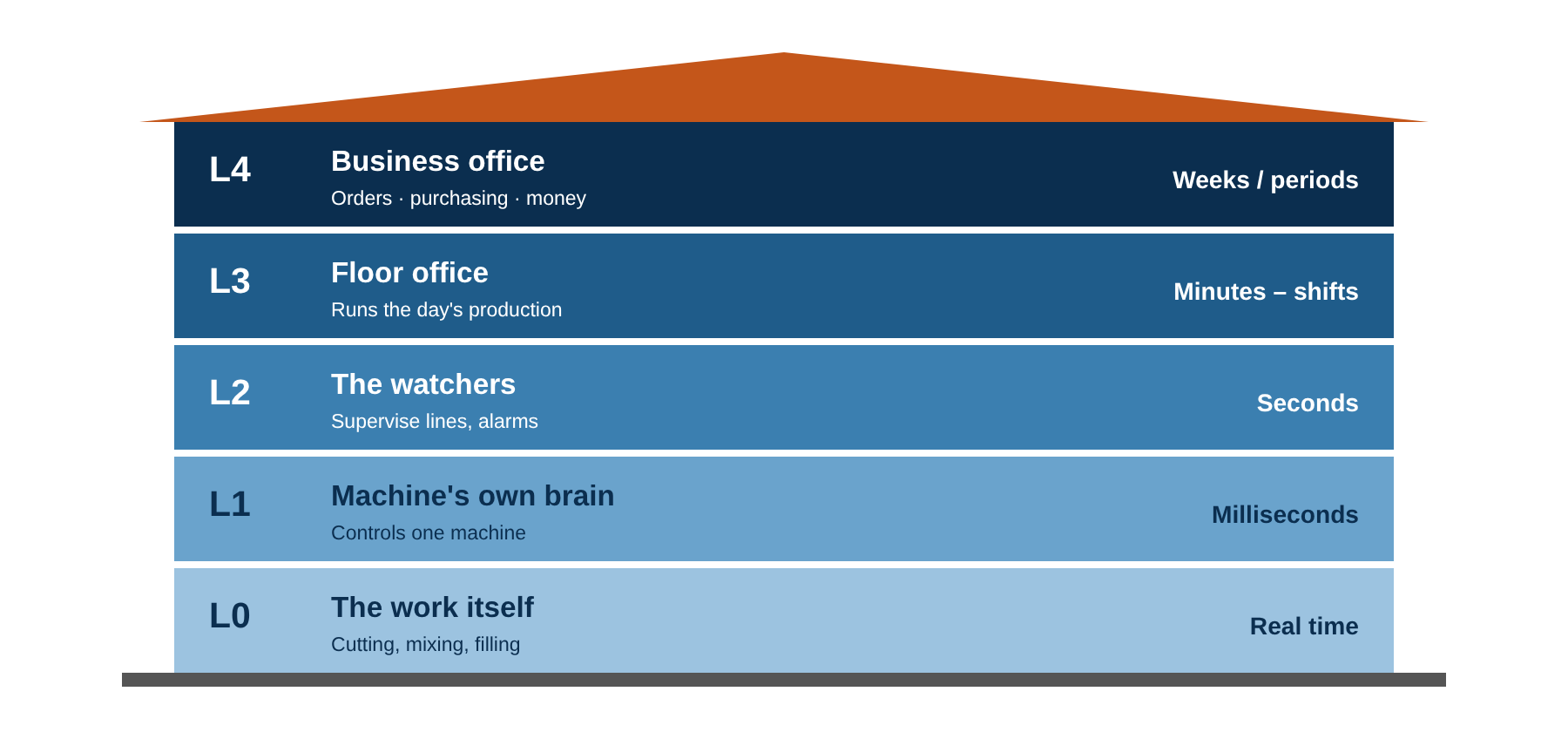
Years ago, the automation industry wrote down how a manufacturing company divides its work. The standard is called ISA-95, and you never need to read it. You only need its picture: one building, five floors.
Level 0 — the work itself. Metal being cut, food being mixed, liquid being filled. Physical things happening.
Level 1 — the machine's own brain. The controls that run one machine or one line, making decisions in fractions of a second: open this valve, hold that temperature, stop now.
Level 2 — the watchers. The screens and systems that supervise the machines, so one person can see a whole line at a glance and catch trouble early.
Level 3 — the floor office. The layer that runs the day's production: which orders go to which machines, in what order, with what materials — and what got made, stopped, or held. This is the floor's memory and its foreman, in system form.
Level 4 — the business office. Orders, purchasing, inventory, accounting. The promises the company makes and the money it keeps.
The standard's real gift is not the floors. It is the clocks. Level 1 thinks in fractions of a second. Level 3 thinks in minutes, shifts, and days. Level 4 thinks in weeks and accounting periods. Most plant confusion comes from asking a system a question that belongs to a different floor — asking the office software what the machine is doing right now, or asking the machine why an order is late.
The cast, decoded
ERP (Level 4) — Enterprise Resource Planning. The business's central ledger and order book: customers, orders, purchasing, inventory value, accounting. It answers: what did we promise, and what is it worth?
CRM (Level 4) — Customer Relationship Management. The memory of every customer conversation: quotes, contacts, follow-ups. It answers: who wants what, and when did we last talk?
PLM (Level 4) — Product Lifecycle Management. The official definition of what you make: drawings, specifications, bills of material, and every approved change to them. It answers: what exactly is this product?
MRP (Level 4, inside the ERP) — Material Requirements Planning. The calculator that explodes a bill of material into three answers: what do we need, what do we have, when must it arrive.
APS (the Level 4/3 doorway) — Advanced Planning and Scheduling. Scheduling against real capacity — the actual machines, people, and hours you have — instead of a calendar that assumes everything is free. It answers: can we honestly make that date?
MES (Level 3) — Manufacturing Execution System. The system that runs production day to day: releases orders to the floor, captures starts, finishes, checks, and stops, and builds the record everyone else trusts. It answers: what is actually happening to this order, this shift?
MOM (Level 3) — Manufacturing Operations Management. The umbrella name for the whole Level 3 job — production, quality, inventory, and maintenance working together. An MES is the heart of it; MOM is the whole floor office.
QMS (Level 3) — Quality Management System. The checkpoints, limits, and dispositions: what gets checked, what passes, what gets held. It answers: is this good, and can you prove it?
CMMS (Level 3) — Computerized Maintenance Management System. The memory of the machines: preventive maintenance schedules, repair requests, failure history. It answers: what breaks, how often, and when did we last service it?
WMS (Level 3) — Warehouse Management System. The physical truth of the storeroom and the dock: where things are, what gets picked, what ships. (The ERP holds what inventory is worth; the WMS holds where it is.)
SCADA (Level 2) — Supervisory Control and Data Acquisition. The watching system: it gathers signals from many machines into one view, with alarms when something drifts.
HMI (Level 2) — Human-Machine Interface. The screen on the machine that the operator actually touches. If SCADA is the control room, the HMI is the dashboard in front of the driver.
PLC (Level 1) — Programmable Logic Controller. The rugged little computer bolted to the equipment, running its logic thousands of times a second. The machine's reflexes.
DCS (Levels 1–2) — Distributed Control System. The PLC's bigger cousin for continuous processes — chemicals, food, liquids — where one control system coordinates a whole process area instead of a single machine.
CNC (Levels 0–1) — Computer Numerical Control. A machine tool with a computer built in, cutting to a program instead of a handwheel. The machinist's skill, written down as instructions the machine follows exactly.
IIoT (not a floor — the wiring between floors) — Industrial Internet of Things. Sensors and connections that let machines report what they are doing upward, so the upper floors stop guessing.
OEE (not a system at all) — Overall Equipment Effectiveness. One number — availability × performance × quality — that says how much of your scheduled time became good product at full speed. Vendors sell it like a product. It is a measurement, and a brutally honest one.
One order, start to finish
Watch a single order travel, and the letters stop being soup. A customer asks for a quote; the request lands in the CRM. The order is won and entered in the ERP. MRP explodes the bill of material: what we need, what we have, when it must arrive. APS checks the promise date against the real load on real machines — not the date we'd like, the date we can defend. When materials and capacity are ready, the MES releases a Production Order to the floor. Operators run it at their work centers; PLCs run the machines, SCADA watches the line, and quality checkpoints hold or pass the work as it moves — a hold actually stops it, until a named person decides otherwise. The WMS picks and ships the finished goods, and the ERP invoices. Afterward, OEE tells you how much of the day became good product, and the floor's record tells you exactly where the rest went. Nobody retyped anything. Each system handed the same order — the same truth — to the next.
The failure mode everyone recognizes
Now the version most plants own. The CRM came from one vendor, the ERP from another, quality lives in a third system, maintenance in a spreadsheet, and scheduling on the whiteboard. Every handoff between letters is a person retyping, re-asking, or reconstructing at the end of the shift. The whiteboard becomes the only integrated system in the building. The problem was never a missing letter. It was that the letters never shared one version of the truth.
The close
If your plant runs on letters that don't talk to each other, we offer a complimentary 30-minute discovery session to map yours: which floors you have, which you're missing, and which ones are just expensive noise. No pitch, just the map.
Chris Chiles
CEO, Chiles & Company | Managing Partner, Biltmore Management Advisors
chris@biltmorema.com | chris@chilesand.co | phone: (828) 521-0297
gotbots.si | biltmoremanagementadvisors.si
Chiles & Company, the process and digital improvement expert for manufacturing and distribution
Got Bots? (gotbots.si), the main brand of Chiles & Company: Digital Teammates and the Max family that put your company's knowledge to work inside the Microsoft 365 you already use.
Biltmore Management Advisors (biltmoremanagementadvisors.si): operator-led consulting and multi-vendor implementation for middle-market manufacturers and distributors.
Built on Max-Knowledge™, the Recursive Improvement Platform™: keeps your plant's know-how inside the Microsoft 365 your team already uses. Includes Max-Product-and-CPQ.
Max-Lean-Six-Sigma, our Lean and Six Sigma platform: a $200M chemical distributor ran Value Stream Mapping four times faster with it.